 Thorswap
Thorswap offers THORChain and Chainflip routes with different pricing and execution rules
Thorswap brings THORChain and Chainflip quotes into the same interface for comparing cross-chain swaps. Choose between available routes using the expected destination amount, applicable fees, and the execution settings attached to each quote. Their liquidity models differ, and faster deposit processing or a streamed trade can change the comparison for the same supported asset pair.
A quote is an estimate for a particular input and route. Execution uses the liquidity and network conditions that apply when the swap processes. The provider's name alone does not determine the final payout or delivery time.
In short: Chainflip Boost can shorten the deposit wait when sufficient liquidity is available, while THORChain streaming swaps spread execution across smaller trades.
Matching assets makes route quotes comparable
Compare available THORChain and Chainflip routes for the same input amount and destination asset. Keep the sending network, receiving network, and token identity identical across both quotes. A ticker can represent tokens on different chains, so matching names alone can leave different settlements under comparison. Keep execution settings visible alongside each payout estimate, and distinguish that estimate from a minimum accepted amount. A quote for a different token contract or destination network answers a different request.
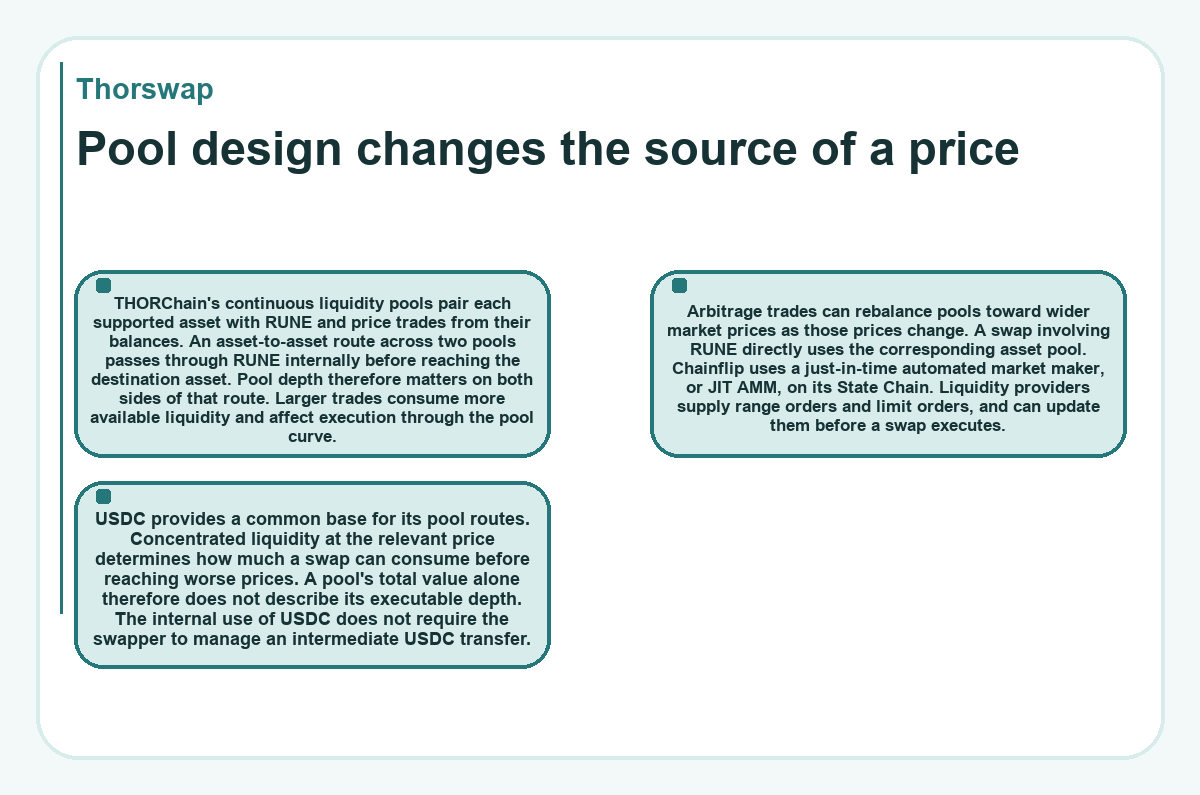
Pool design changes the source of a price
THORChain's continuous liquidity pools pair each supported asset with RUNE and price trades from their balances. An asset-to-asset route across two pools passes through RUNE internally before reaching the destination asset. Pool depth therefore matters on both sides of that route. Larger trades consume more available liquidity and affect execution through the pool curve. Arbitrage trades can rebalance pools toward wider market prices as those prices change. A swap involving RUNE directly uses the corresponding asset pool.
Chainflip uses a just-in-time automated market maker, or JIT AMM, on its State Chain. Liquidity providers supply range orders and limit orders, and can update them before a swap executes. USDC provides a common base for its pool routes. Concentrated liquidity at the relevant price determines how much a swap can consume before reaching worse prices. A pool's total value alone therefore does not describe its executable depth. The internal use of USDC does not require the swapper to manage an intermediate USDC transfer.
Trading fees and delivery costs shape the payout
Thorswap's exchange fee is a separate charge from underlying protocol and blockchain costs. Transaction value and eligible discounts affect that interface charge. The applicable exchange fee appears in the fee breakdown for the requested swap. A discount on that component does not waive liquidity fees or the network costs associated with settlement.
THORChain calculates its slip-based liquidity fee from swap size and pool depth. Minimum fee floors can also govern the charge. Its outbound fee covers destination-chain gas and protocol overhead, using a dynamic multiplier. This fee changes independently of the interface's exchange fee.
Chainflip charges liquidity fees at the pool level, alongside a protocol network fee and any broker or affiliate commission. Deposit-handling and outbound broadcast costs add separate network-related deductions. An eligible boosted deposit adds a Boost fee when boosting succeeds. The breakdown needs to cover the complete route, including internal pool conversions, before comparing quoted payouts.
Funding a swap also costs the sending wallet its source-chain transaction fee. This payment is separate from the assets that the protocol later delivers. Include that wallet expense in the overall cost comparison. Token amounts and fee values in another currency need a common valuation before they can be added.
A fee breakdown may show costs that the quoted payout already includes. Subtracting those deductions again understates the expected delivery amount.
Streaming and Boost affect different parts of the wait
THORChain streaming swaps spread execution across smaller internal swaps. That approach can reduce the liquidity pressure of a large trade, while extending its execution period. Chainflip also supports chunked execution through its dollar-cost averaging parameters. Both mechanisms affect how the trade consumes liquidity over time. The settings available in the selected Thorswap route determine the execution that the interface requests. Protocol support alone does not establish that every option appears for every pair.
Boost acts on Chainflip's incoming deposit. Boost liquidity supplies collateral for a deposit that validators have pre-witnessed, allowing execution before the usual confirmation safety margin completes. It does not remove the time needed for outbound settlement. The whole deposit needs sufficient Boost liquidity at or below the selected maximum Boost fee; otherwise it follows regular confirmation processing without a Boost charge. Faster deposit processing remains conditional, and the setting does not promise a better trading price.
In this hypothetical comparison, both providers offer a route for the same assets and input amount. The quoted payouts and timing estimates are assumed, and earlier expected delivery takes priority over receiving more destination assets. A streaming THORChain quote estimates a larger payout. A Chainflip quote with eligible Boost estimates a smaller payout and earlier delivery.
The Chainflip quote fits the stated preference, with less estimated output. Streaming accounts for part of the THORChain execution period; Boost reduces the incoming-deposit wait in the Chainflip estimate. If Boost liquidity proves insufficient, regular confirmation processing applies and the timing advantage may disappear.
Price protections use different limits and fee calculations
Price protection governs whether a swap can execute under the terms encoded in its request. THORChain supports a minimum-output limit in its swap instructions. Its quote API can derive the limit from expected output, accounting for swap and outbound fees. It also has an input-value-based tolerance parameter that excludes those fee adjustments. A percentage beside a route therefore needs the associated calculation to explain the permitted price change.
Chainflip supports a minimum accepted price and, for eligible assets, a maximum deviation from an oracle price. Both price checks must pass when a request includes both protections. Both checks operate at the AMM layer and exclude deposit and broadcast fees. The minimum-price check accounts for network and broker fees, while live price protection checks each pool leg without those fees. The request also specifies a refund address and retry duration, which the protocol measures in blocks. If the required price conditions remain unmet through that duration, the unexecuted funds return to the refund address.
Active settlement determines route availability
Route availability requires working deposits, trading, and outbound settlement for the chosen assets. THORChain can halt these functions globally or for an individual chain. Chainflip's September 15, 2026 recovery plan excluded TRON from the initial restart after a vault exploit. The plan made TRON reopening conditional on its witnessing process catching up. A supported asset can therefore remain temporarily unavailable on a particular route. Do not send against a halted route or reuse an expired quote.
Worth knowing
Can I choose Chainflip when Thorswap recommends a THORChain route?
You can choose a Chainflip route when Thorswap offers it for your selected asset pair. The interface can recommend a route automatically and offer alternatives. Choosing another offered provider changes the execution path and its associated terms. It does not add support for a missing pair. Refresh the quote after switching, since the payout estimate and available settings belong to the selected route.
Does selecting Chainflip always avoid an ERC-20 approval?
An ERC-20 approval depends on the deposit method that the Chainflip route uses. A deposit-channel swap accepts a direct transfer of the input tokens without approving a swapping contract. A vault swap on an Ethereum Virtual Machine (EVM) network can require an allowance so its contract can take the tokens. Native-coin transfers do not use ERC-20 allowances. The provider name alone does not identify the authorization that the actual sending transaction requires.
Is a direct Chainflip quote always cheaper than a Thorswap quote?
A direct Chainflip quote can have different broker or interface fees, while the underlying protocol costs still apply. Different frontends can attach different broker and affiliate parameters to a swap. Liquidity, network, and settlement charges follow the relevant Chainflip path. Compare quotes with the same assets, amount, deposit method, and execution settings. A difference in the service fee can coexist with a different final payout.
Why can the same THORChain swap receive a different quote through another affiliate?
Eligible THORChain native-asset swaps can use an affiliate-specific minimum liquidity fee when the affiliate has active dynamic-fee enrollment. The qualifying request needs the affiliate's valid registered THORName and a nonzero affiliate fee. An unenrolled affiliate does not trigger that dynamic floor. This mechanism changes the pool's minimum liquidity charge separately from the affiliate's commission. Comparing an affiliate-free quote with a qualifying affiliate quote can therefore change more than the listed service fee.
Can a Chainflip refund return less than the amount I deposited?
A Chainflip refund can return less than the original deposit because refund processing has its own costs. The protocol applies its refund fee, and returned funds remain subject to the source-chain broadcast fee. A Boost fee already charged for a boosted deposit is not refunded. For chunked swaps, completed chunks produce destination assets; only the unexecuted remainder returns to the refund address. Those amounts represent different assets and cannot be treated as one unchanged deposit.
What happens to saved deposit instructions when I change route providers?
Saved deposit instructions apply to the provider and swap request that created them. THORChain deposit instructions depend on the current vault address and the transaction's swap instructions. A Chainflip deposit channel carries its own asset selection, destination, and expiry. Changing the provider requires fresh instructions for that route. Even within the same provider, an expired quote or channel can make previously saved deposit details unsuitable.